Skip to content Skip to sidebar Skip to footer

BAAI Launches OmniGen2: A Unified Diffusion and Transformer Model for Multimodal AI

Beijing Academy of Artificial Intelligence (BAAI) introduces OmniGen2, a next-generation, open-source multimodal generative model. Expanding on its predecessor OmniGen, the new architecture unifies text-to-image generation, image editing, and subject-driven generation within a single transformer framework. It innovates by decoupling the modeling of text and image generation, incorporating a reflective training mechanism, and implementing a purpose-built…

Read More

UC San Diego Researchers Introduced Dex1B: A Billion-Scale Dataset for Dexterous Hand Manipulation in Robotics

Challenges in Dexterous Hand Manipulation Data Collection Creating large-scale data for dexterous hand manipulation remains a major challenge in robotics. Although hands offer greater flexibility and richer manipulation potential than simpler tools, such as grippers, their complexity makes them difficult to control effectively. Many in the field have questioned whether dexterous hands are worth the…

Read More

ByteDance Researchers Introduce VGR: A Novel Reasoning Multimodal Large Language Model (MLLM) with Enhanced Fine-Grained Visual Perception Capabilities

Why Multimodal Reasoning Matters for Vision-Language Tasks Multimodal reasoning enables models to make informed decisions and answer questions by combining both visual and textual information. This type of reasoning plays a central role in interpreting charts, answering image-based questions, and understanding complex visual documents. The goal is to make machines capable of using vision as…

Read More

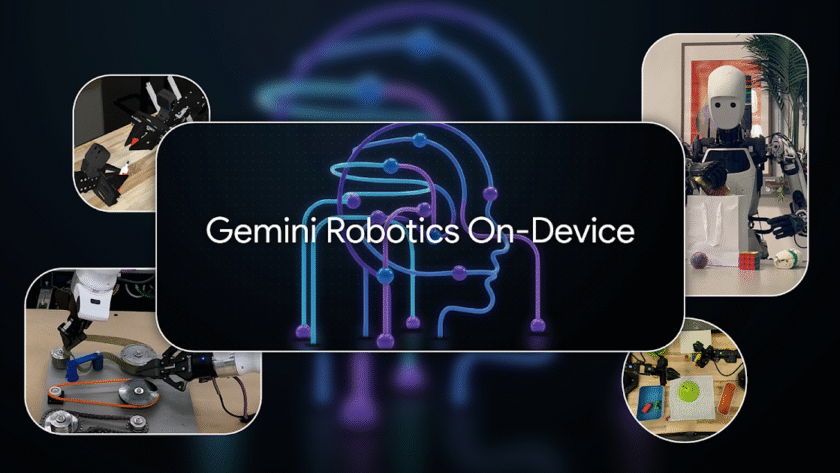
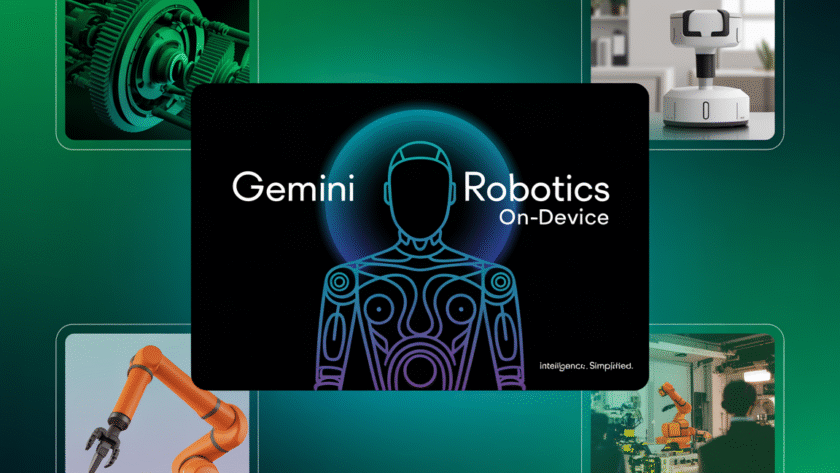
Google DeepMind Releases Gemini Robotics On-Device: Local AI Model for Real-Time Robotic Dexterity

Google DeepMind has unveiled Gemini Robotics On-Device, a compact, local version of its powerful vision-language-action (VLA) model, bringing advanced robotic intelligence directly onto devices. This marks a key step forward in the field of embodied AI by eliminating the need for continuous cloud connectivity while maintaining the flexibility, generality, and high precision associated with the…

Read More

EPFL Researchers Unveil FG2 at CVPR: A New AI Model That Slashes Localization Errors by 28% for Autonomous Vehicles in GPS-Denied Environments

Navigating the dense urban canyons of cities like San Francisco or New York can be a nightmare for GPS systems. The towering skyscrapers block and reflect satellite signals, leading to location errors of tens of meters. For you and me, that might mean a missed turn. But for an autonomous vehicle or a delivery robot,…

Read More